In many electronic circuits, multiple transistors work together and must behave nearly identically to ensure balanced operation and reliability. This practice, known as transistor matching, is critical in designs such as differential amplifiers, current mirrors, and push-pull stages. While integrated circuits can provide inherently matched pairs on a single die, discrete transistors often vary even within the same part number. This article explores the why and how of transistor matching, including the parameters to consider and common pitfalls.
What does it mean to match transistors?
Transistor matching refers to selecting two or more discrete transistors that have very similar electrical characteristics, such as current gain (hFE) or saturation voltage. In practice, you measure these parameters and pair devices that fall within a tight tolerance of each other. For example, if you need two NPN transistors for a differential pair, you might test a batch and pick ones where the hFE values are within 5% of each other. The goal is to make the transistors behave as uniformly as possible in the circuit, minimizing imbalance and ensuring predictable performance.
Why is transistor matching necessary in circuits?
When transistors work in tandem, especially in configurations like current mirrors or differential amplifiers, any mismatch can cause one device to carry more current than the other. This leads to inefficiency, increased heat dissipation, and potential failure of the overloaded transistor. Matching ensures that load sharing is even, preserving the longevity of components and maintaining circuit accuracy. In bridge circuits, the same principle applies to resistors or capacitors: you want two 10% tolerance parts to actually be very close to each other in value, such as both measuring 9.2Ω instead of one being 9Ω and the other 11Ω.
How does matching differ from impedance matching?
These two concepts are often confused but serve different purposes. Impedance matching aims to maximize power transfer by making the source impedance equal to the load impedance, typically at a specific frequency. In contrast, transistor matching ensures that two or more devices have nearly identical electrical parameters (like gain or VCE(sat)) so they behave uniformly in a circuit. Impedance matching is about the relationship between source and load, while transistor matching is about device-to-device consistency. They are unrelated in both goal and method.
What parameters are typically matched?
Depending on the circuit application, different parameters take priority. Most commonly, engineers match DC current gain (hFE or β) so that each transistor amplifies equally. In saturation applications, matching VCE(sat) (collector-emitter saturation voltage) is crucial to ensure both devices turn on fully at the same input level. For high-speed switching, matching capacitance and transition frequencies may also be important. The key is to identify which parameter most affects circuit balance and then select components that are within 1–5% of each other for that parameter.
What happens if you use unmatched transistors?
Using unmatched transistors can lead to several problems. In a current mirror, one transistor may carry significantly more current, causing it to overheat and fail prematurely. In a differential amplifier, mismatch introduces offset voltage and reduces common-mode rejection. The circuit becomes less efficient, more prone to distortion, and less predictable overall. Even in simple push-pull stages, mismatched gains can cause crossover distortion. In essence, the circuit's performance degrades, and reliability suffers.
How are matched transistor pairs produced in ICs?
Integrated circuits (ICs) that contain matched transistor pairs are fabricated on a single piece of silicon, ensuring the devices share identical physical properties. Since they are made simultaneously under the same conditions, their electrical characteristics are extremely close. This is why you can buy ICs like the LM3046 or MAT04 that contain multiple well-matched transistors on one die. Such parts are ideal for precision analog circuits where discrete matching would be tedious and imperfect.
How can you match discrete transistors?
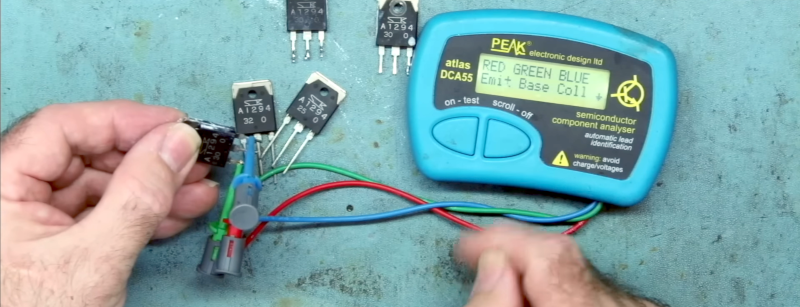
To match discrete transistors, you need to measure each candidate's relevant parameter—typically gain (hFE)—using a multimeter with a transistor test function or a dedicated component tester. Sort the devices into groups where the measured values fall within a narrow band, such as ±2% of a target. For saturation voltage matching, you can build a simple test circuit and compare VCE(sat) under identical bias conditions. Label the matched pairs for future use. While this process is more labor-intensive than buying a matched IC, it allows you to use standard parts and achieve acceptable balance for many applications.