In the early hours of May 3rd, a SpaceX Falcon 9 rocket lifted off from Vandenberg Space Force Base, carrying 45 satellites into orbit. Among them were three new Pelican spacecraft—Pelicans 7, 8, and 9—joining the Planet Labs fleet. But this launch was more than just another batch of hardware; it represents a fundamental shift in how we access Earth observation data. Planet Labs isn't just selling images—it's selling a subscription to watch the entire planet change in real time. Here are ten things you need to know about this groundbreaking service.
1. The Core Concept: Subscription-Based Earth Monitoring
Planet Labs has flipped the traditional satellite imagery model on its head. Instead of purchasing individual snapshots or high-res images, customers pay a recurring subscription fee for continuous access to a constantly updating mosaic of the Earth's surface. This means you don't just get a picture of what a place looked like last week; you get daily, sometimes sub-daily, imagery of nearly every landmass. The subscription model allows Planet Labs to spread costs across thousands of users, making frequent, high-resolution monitoring affordable for everyone from agribusinesses to governments.
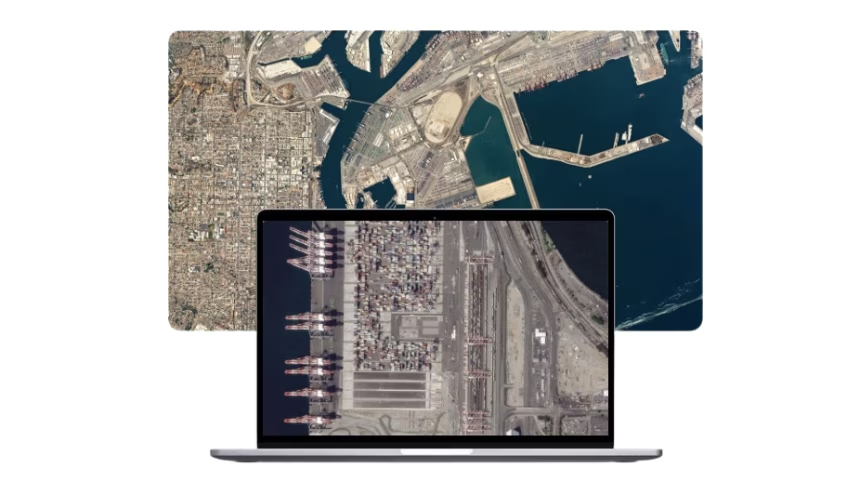
2. The Pelican Constellation: Next-Generation High-Resolution
The Pelican satellites are the workhorses of Planet's next-generation constellation. With the addition of Pelicans 7, 8, and 9, the fleet now stands at nine spacecraft. Each Pelican is designed to capture 30 cm resolution imagery—sharp enough to identify individual vehicles, trees, or changes in building structures. This is a huge leap from the earlier Dove satellites, which offered 3-meter resolution. Pelicans also feature advanced spectral bands and onboard processing, enabling near-real-time analytics directly from the satellite.
3. How the Subscription Differs from Traditional Sales
Traditionally, satellite imagery has been sold on a per-scene or per-square-kilometer basis. Customers would buy a specific image taken at a specific time, much like purchasing a stock photo. Planet Labs' subscription model changes that to an access-based approach. For a fixed monthly fee, subscribers get unlimited downloads of Planet's basemaps, daily updated mosaics, and the ability to query historical archives. There's no per-use charge, so you can monitor changes as often as you like without worrying about incremental costs.
4. Real-Time Change Detection at Global Scale
The ability to watch the entire planet change in near real time is the killer app. Planet Labs uses its network of hundreds of satellites (Dove, SuperDove, and now Pelican) to image every point on Earth every day. Machine learning algorithms automatically compare new images with previous ones to flag changes: a new building, deforestation, crop stress, or even ship movements. Subscribers receive alerts and can drill into specific areas. This capability has been used to monitor military activity, track illegal fishing, and verify climate pledges.
5. Fleet Composition: Doves, SuperDoves, and Pelicans
Planet Labs operates a diverse fleet. The original Doves (3-meter resolution) provide global daily coverage and form the backbone of the monitoring system. SuperDoves offer improved spectral bands and 3-meter resolution as well. The new Pelican constellation (30 cm resolution) is the premium tier—covering specific areas of interest with much sharper detail. Together, they create a tiered service: broad, frequent coverage from Doves/SuperDoves, plus high-resolution spot checks from Pelicans. This combination is what makes the subscription model viable.
6. Launch Strategy: Rideshare Missions for Cost Efficiency
Planet Labs launches its satellites as secondary payloads on rockets like SpaceX's Falcon 9. The May 3rd launch was a classic rideshare: 45 satellites from multiple companies, with Planet's three Pelicans hitching a ride. This keeps launch costs low, allowing Planet to deploy constellations rapidly and cheaply. Each Pelican satellite is small—roughly the size of a mini-fridge—so multiple can fit in a single launch. This strategy ensures that the subscription service can scale without skyrocketing capital expenses.

7. Applications Across Industries
The subscription model opens up Earth observation to a wide range of users. Agriculture: Farmers monitor crop health daily, compare vegetation indices, and optimize irrigation. Defense and Intelligence: Governments track changes in sensitive sites without needing to task satellites individually. Environmental Monitoring: NGOs use Planet imagery to detect deforestation, oil spills, and glacier retreat in near real time. Insurance and Finance: Insurers assess disaster damage and verify crop yields for parametric insurance. Each industry pays a subscription and integrates data feeds into their workflows.
8. Pricing and Subscription Tiers
Planet Labs offers several subscription plans, though exact pricing is custom-quoted. The basic tier might include daily Dove mosaics with 3-meter resolution for a few thousand dollars a year. The advanced tier adds SuperDove data and historical archives. The enterprise tier includes Pelican high-resolution access, priority tasking, and API integration. The key is that pricing is based on access, not data volume. A university researcher might pay a fraction of what a government agency pays, but both get unlimited platform access during their subscription period.
9. Integration with Analytics and APIs
A subscription is only as valuable as the insights it provides. Planet Labs offers a cloud-based platform with APIs and pre-built analytics. Users can query the imagery database using spatial and temporal filters, run change detection algorithms, and export data in common GIS formats. The platform supports integration with tools like QGIS, ArcGIS, and custom Python scripts. For developers, the API allows building custom applications—for example, a dashboard that automatically alerts when a monitored area shows new construction or vegetation loss.
10. The Future: Expanding Coverage and Resolution
With Pelican 7, 8, and 9 now in orbit, Planet Labs is on track to grow the Pelican constellation to dozens of satellites. Plans include adding more spectral bands (including shortwave infrared for night imaging and thermal) and eventually offering sub-30 cm resolution. Additionally, the subscription model may evolve to include on-demand tasking for urgent events, like natural disasters. Planet also continues to improve its machine learning models for automated change detection. The goal: a continuously updated digital twin of Earth, available to anyone with a subscription.
Planet Labs' subscription service transforms satellite imagery from a static commodity into a dynamic, real-time intelligence tool. The launch of the latest Pelican satellites is just one more step toward making global, daily, high-resolution monitoring accessible to all. As the constellation grows and analytics improve, the ability to watch the entire planet change—not just as a series of snapshots, but as a living feed—will become an indispensable resource for businesses, governments, and citizens alike.