Introduction
The first quarter of 2026 marks a pivotal shift in the ransomware ecosystem. After a period of intense fragmentation, the threat landscape is consolidating around a smaller number of dominant operators. At the same time, the overall volume of attacks remains at historically elevated levels, with new groups emerging and established players evolving. This article examines the key trends and data from Q1 2026, revealing a landscape that is both stabilizing and transforming.
Volume Stabilizes at High Levels
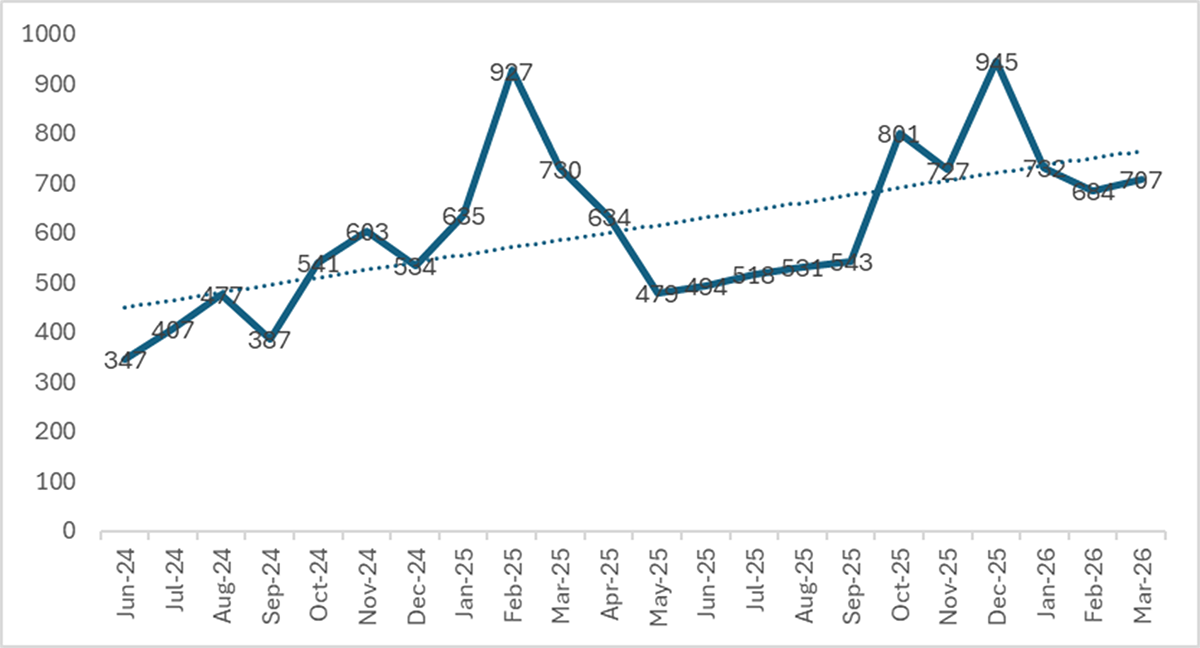
During Q1 2026, security researchers tracked over 70 active data leak sites (DLS) that collectively posted 2,122 victims. While this figure represents a 12.2% decline from the all-time record of 2,416 victims seen in Q4 2025, it remains the second-highest Q1 on record. More importantly, it is 117% above Q1 2024 (977 victims), underscoring the sustained high baseline established throughout 2025.
Monthly Distribution
Monthly volumes remained remarkably stable: January recorded 732 victims, February 684, and March 706. This consistency yields an average of 707 victims per month, indicating that ransomware operations have reached a steady state of high activity. The year-over-year comparison with Q1 2025 (2,285 victims) shows a headline decline of 7.1%, but that figure is misleading. The Q1 2025 numbers were artificially inflated by Cl0p’s Cleo mass-exploitation campaign, which contributed roughly 390 victims in a single burst. Excluding Cl0p from both periods reveals a 5.3% year-over-year increase (1,894 victims in Q1 2025 vs. 1,995 in Q1 2026). The underlying growth trend persists even as the most dramatic spikes subside.
Consolidation After Fragmentation
The most significant structural development in Q1 2026 is not the volume of attacks but the consolidation of operators. After two years of steady fragmentation—when the number of active groups grew from 51 in Q1 2024 to a peak of 85 in Q3 2025, and the top-10 share of victims fell from 68% to 57%—the ecosystem has decisively reversed course.
Top Groups Regain Dominance
In Q1 2026, the top 10 ransomware groups accounted for 71.1% of all DLS-posted victims, the highest concentration since Q1 2024 when the ecosystem was far smaller. The total number of active groups shrank from 85 to 71. Fourteen groups that were active in Q4 2025 disappeared entirely, while 21 new names appeared. This churn indicates a maturing market where established operators are absorbing or outcompeting smaller players.
Notable Groups in Q1 2026
Qilin’s Continued Dominance
Qilin maintained its position as the most prominent ransomware operation for the third consecutive quarter, posting 338 victims. Its sustained dominance reflects a combination of technical sophistication, effective affiliate programs, and consistent targeting across multiple sectors. Qilin’s resilience demonstrates that even in a consolidating landscape, top-tier groups can retain market share.
The Gentlemen’s Rapid Rise
The breakout story of Q1 2026 is The Gentlemen, which surged to third place in the global ransomware rankings. Their victim count skyrocketed from just 40 in Q4 2025 to 166 in Q1 2026. This explosive growth highlights the potential for new entrants to disrupt the established order, even as the ecosystem consolidates. The Gentlemen’s tactics appear to favor speed and volume, leveraging perhaps newer exploits or aggressive affiliate recruitment.
LockBit 5.0 Comeback
LockBit reasserted its relevance with the launch of version 5.0, posting 163 victims in Q1 2026 and climbing to fourth place. After a period of relative decline following law enforcement takedowns and internal turbulence, LockBit’s resurrection signals that even the most disrupted groups can return with renewed capabilities. The LockBit 5.0 variant reportedly includes improved encryption and evasion techniques.
Conclusion
The ransomware landscape in Q1 2026 is defined by a paradox: consolidation at the top alongside the emergence of new, aggressive groups. Volume has stabilized at historically high levels, with monthly averages around 707 victims. The top 10 groups now control 71% of the market, reversing the fragmentation trend of 2024-2025. Qilin remains the unchallenged leader, but The Gentlemen and LockBit 5.0 are reshaping the competitive dynamics. Organizations must prepare for a threat environment that is both concentrated (with fewer, more powerful adversaries) and dynamic (with new players ascending quickly). The key takeaway: ransomware is not going away—it is evolving into a more structured, yet still volatile, criminal enterprise.