In the fast-paced world of digital advertising, delivering the right ad to the right user at the right moment is a monumental challenge. Spotify Engineering recently unveiled a novel approach to tackling this complexity: a multi-agent AI architecture. Rather than relying on a single monolithic model, this system divides advertising tasks among specialized agents that work in concert. The result is not just smarter ad placement but a scalable framework that adapts to dynamic user behavior and advertiser goals.
The Challenge of Personalized Advertising at Scale
Advertising on a platform like Spotify, which serves millions of users across diverse genres and listening habits, requires deep personalization. Traditional systems often use a single AI model to predict click-through rates or optimize bids. However, this approach struggles with the sheer number of variables: user context (mood, time of day, device), ad inventory (audio, video, display), and campaign objectives (brand awareness, conversion). A monolithic model becomes unwieldy, hard to update, and prone to cascade failures.
Why a Single AI Agent Falls Short
Single-agent systems treat advertising as one optimization problem, but in reality, it encompasses several distinct subproblems. For instance, understanding user intent is different from selecting a creative or managing a budget. When all these tasks are handled by one model, it often leads to compromises—enhancing one metric can hurt another. Moreover, debugging performance issues becomes a nightmare because multiple factors are entangled.
Our Multi-Agent System: Division of Labor
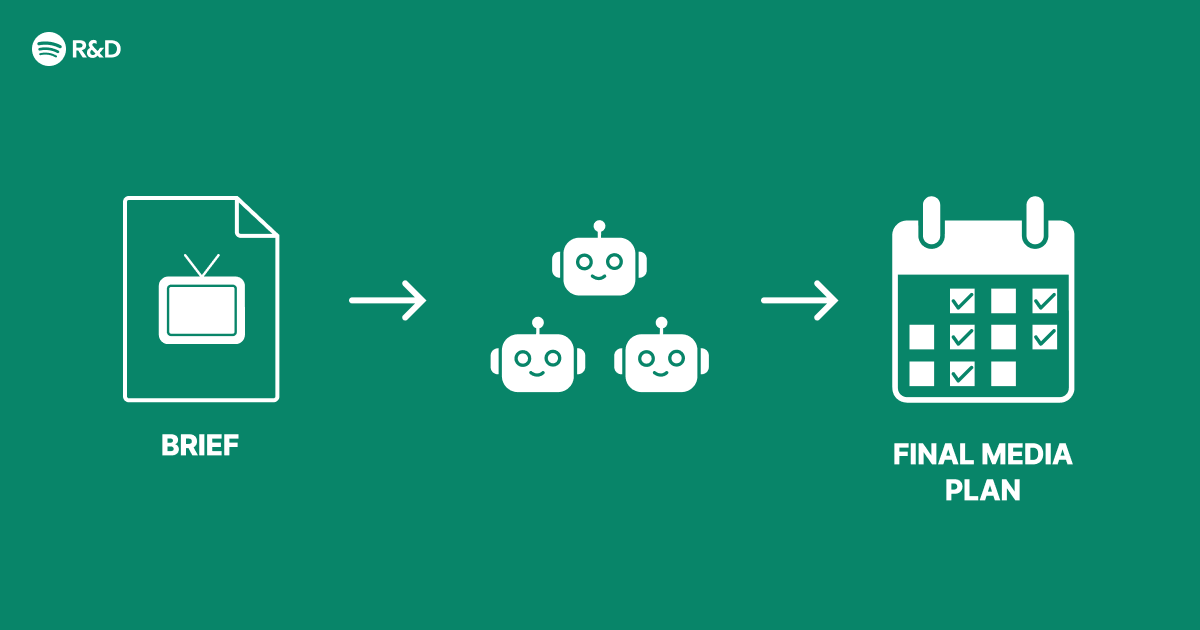
Spotify's multi-agent architecture breaks down the advertising pipeline into specialized agents, each responsible for a specific function. These agents operate semi-autonomously but are coordinated by a central orchestrator that ensures overall coherence. This modular design brings several advantages: easier debugging, faster iteration, and the ability to swap or upgrade agents without disrupting the entire system.
Agent 1: Audience Understanding
This agent focuses on user profiling and segmentation. It consumes streaming data, listening history, and contextual signals to determine which users are most likely to engage with a given campaign. It uses techniques like collaborative filtering and sequence modeling to predict user affinity [footnote]. By isolating this task, the team can refine audience targeting without affecting other components.
Agent 2: Creative Optimization
Once the audience is identified, the creative optimization agent selects the best ad format and message. It experiments with different audio scripts, video lengths, and call-to-action placements. This agent leverages reinforcement learning to maximize engagement metrics like completion rate and brand recall. It continuously learns from real-time feedback, adjusting which creative variants to serve.
Agent 3: Bid and Budget Management
Real-time bidding is one of the trickiest parts of programmatic advertising. This agent monitors auction dynamics and sets optimal bids for each impression opportunity. It also manages campaign budgets across multiple channels, ensuring spend is allocated efficiently. By operating as a standalone module, it can run simulations and adjust strategies without interfering with other agents' calculations.

Agent 4: Performance Monitoring and Adaptation
The fourth agent acts as the system's watchdog. It continuously tracks key performance indicators (KPIs) such as cost per acquisition, ad frequency, and user feedback (e.g., skips, dislikes). If it detects anomalies—such as a sudden drop in click-through rate or budget overspend—it triggers alerts and can even pause underperforming campaigns. This agent also feeds insights back to the other agents, enabling a closed-loop optimization cycle.
Coordinating the Agents: A Central Orchestrator
To avoid conflicts between agents (e.g., the bid agent may want to spend aggressively while the performance agent urges caution), a central orchestrator resolves conflicts and aligns goals. This orchestrator uses a shared communication protocol, allowing agents to exchange information about their current state and predictions. For instance, when the audience agent identifies a high-value user segment, it signals the creative agent to prepare premium ad formats, and the bid agent to allocate a higher budget for that segment.
Results and Future Directions
Initial deployments of the multi-agent architecture have shown measurable improvements: higher ad relevance scores, reduced wasted ad spend, and improved user satisfaction (fewer irrelevant ads). Spotify Engineering reports that the modular structure has accelerated development cycles, as each agent can be independently tested and optimized. Looking ahead, the team plans to introduce agents that handle cross-platform attribution and experiment with meta-learning to adapt agents to entirely new advertising verticals.
This multi-agent approach represents a shift from monolithic AI to a collaborative ecosystem. By allowing specialized models to focus on their strengths while communicating through a clear orchestration layer, Spotify has built an advertising system that is not only smarter but also more resilient and easier to evolve.