Introduction
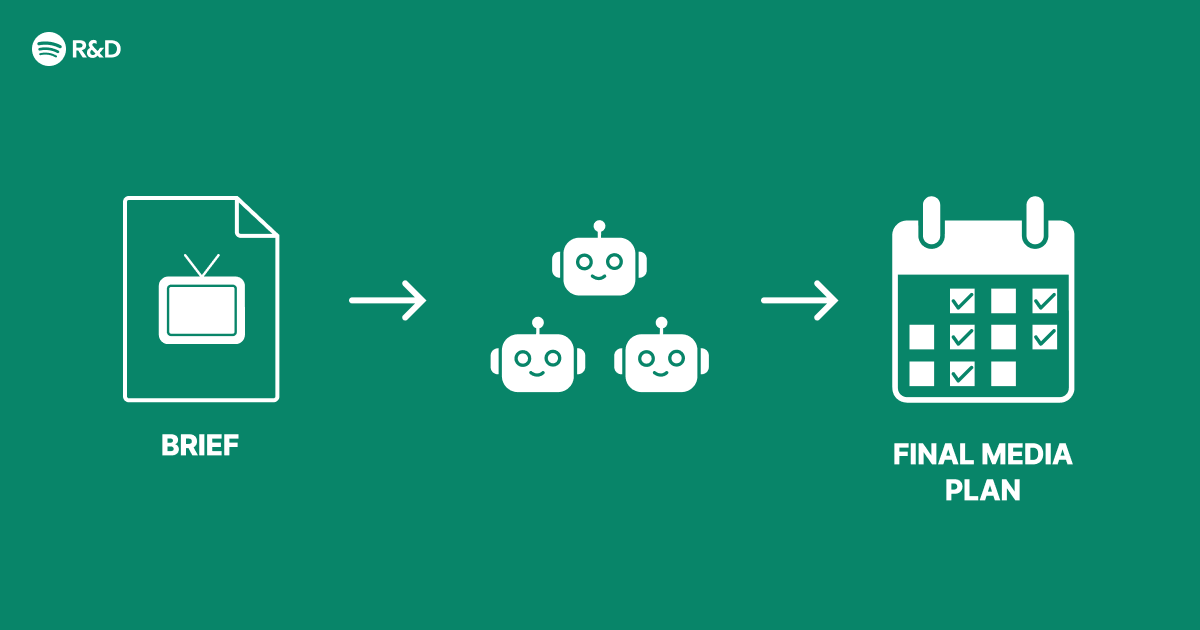
Imagine your advertising system as a team of specialists—each with a unique role, communicating and collaborating to serve the perfect ad at the perfect moment. That’s the power of a multi-agent architecture. Rather than relying on a single monolithic AI model, you deploy multiple specialized agents that handle specific tasks: one might predict user intent, another optimizes bid prices, and a third crafts creative copy. Together, they produce smarter, more adaptive advertising outcomes. This guide walks you through building such a system from the ground up, based on real-world engineering practices (inspired by approaches at companies like Spotify). By the end, you’ll have a clear roadmap to design, implement, and scale your own multi-agent advertising platform.
What You Need
- Technical stack: Python (3.8+), a deep learning framework (PyTorch or TensorFlow), and a message broker (e.g., RabbitMQ, Kafka).
- Data infrastructure: Access to historical ad impression logs, user interaction data, and campaign metadata. Stored in a distributed database (e.g., Cassandra, BigQuery).
- Compute resources: GPU instances for model training (AWS EC2 P3 or GCP A2) and CPU instances for real-time inference.
- Basic knowledge: Reinforcement learning, multi-agent systems, microservices architecture, and ad tech fundamentals (CPM, CPC, RTB).
- Team: At least one ML engineer, one data engineer, and one backend developer.
Step 1: Define Agent Roles and Responsibilities
Start by breaking down your advertising pipeline into discrete tasks. In a typical multi-agent ad system, you’ll want at least these agents:
- User Profiler Agent: Analyzes user behavior, demographics, and context to create a real-time interest vector.
- Bid Optimizer Agent: Determines the optimal bid price for each ad impression based on predicted conversion probability and budget constraints.
- Creative Selector Agent: Chooses the most relevant ad creative (image, copy, video) from a pool, using past performance and user profile.
- Budget Manager Agent: Tracks campaign budgets across time, pausing or adjusting allocation when limits are reached.
- Orchestrator Agent: Coordinates the other agents, manages communication, and handles fallback logic.
Clearly specify the inputs, outputs, and decision boundaries for each agent. This modularity lets you update one agent without breaking the whole system.
Step 2: Design the Communication Protocol
Agents must talk to each other—but in a decoupled, asynchronous way. Use a publish/subscribe pattern (e.g., Kafka topics) for high throughput. Define a shared message schema (like Protocol Buffers or Avro) containing fields such as impression_id, user_vector, candidate_ads, bid_price, etc. Each agent subscribes to relevant topics and publishes its output. The Orchestrator listens to all and manages the flow. Ensure idempotency: messages can be redelivered without double-spending. Latency matters: aim for end-to-end response under 100ms for real-time bidding.
Step 3: Build Each Agent with a Focus on Autonomy
For each agent, create an independent microservice that exposes an internal gRPC or REST API (for synchronous calls) and also consumes/publishes via the message queue. The agent should have its own dedicated ML model or rule engine. For example:
- User Profiler: Use a transformer-based sequential model (e.g., NARM) trained on user clickstreams. Deploy as a lightweight server.
- Bid Optimizer: Implement a deep Q-network (DQN) or a bandit algorithm that takes state (user vector, ad features, remaining budget) and outputs bid price.
- Creative Selector: Use a multi-armed bandit with contextual embeddings (e.g., through a Siamese network) to balance exploration and exploitation.
Each agent should run in its own container (Docker) with health checks, logging, and a fallback policy (e.g., degrade gracefully by skipping optimisation if model is unavailable).
Step 4: Implement the Orchestrator Layer
The Orchestrator is the brain of your system. It receives an incoming ad request (e.g., from a publisher’s ad server), then does the following in sequence:
- Invoke the User Profiler (async) to enrich the request with a user vector.
- Query the Budget Manager for available spend.
- Call the Creative Selector to pick the best ad for that user.
- Call the Bid Optimizer to set a price.
- Return the final decision to the ad server.
Use a state machine pattern: the Orchestrator tracks the state of each request across agent responses. If an agent times out or errors, the Orchestrator can either retry or fall back to default logic. Log all decisions for offline analysis.

Step 5: Train Agents Collaboratively (or Independently)
You have two training approaches:
- Independent training: Train each agent on historical data in isolation. For example, train the Bid Optimizer using logged bid responses and outcomes, assuming the Creative Selector is fixed. This is simpler but may lead to suboptimal joint performance.
- Joint training with a reward function: Use a central reward signal (e.g., total revenue or click-through rate) to tune all agents simultaneously. This can be done via reinforcement learning with a shared critic or gradient-based multi-agent optimisation (e.g., MADDPG). For advertising, start with independent training, then iterate toward joint fine-tuning.
To avoid feedback loops (where one agent’s changes break others), maintain a staging environment where agents are tested against copies of the others.
Step 6: Deploy with Gradual Rollout and A/B Testing
Don’t flip the switch for all traffic at once. Start with a shadow mode: the multi-agent system runs in parallel with your current system but its decisions are logged but not served. Measure offline simulation metrics. Then, roll out to a small percentage of live traffic (e.g., 1%) using a feature flag. Monitor key indicators: revenue, latency, error rates. Gradually increase traffic while comparing against a control group. Use A/B testing to isolate the impact of each agent (e.g., test only the new Bid Optimizer vs. old).
Step 7: Monitor, Log, and Iterate
Build a dashboard (using Prometheus + Grafana, or similar) that shows per-agent latency, throughput, decision distribution, and reward trends. Also log all decisions with unique IDs to enable offline analysis. Set up alerts for anomalies (e.g., agent not responding, unexpected spike in bids). Regularly retrain agents with fresh data (weekly or daily). Introduce new agents gradually—for example, a “Fraud Detector Agent” that scores requests for validity. The modular architecture makes it easy to add without rewriting the core.
Conclusion & Tips
Building a multi-agent advertising system is not a one-time project; it’s an evolving platform. The key advantage is flexibility: you can swap out an underperforming agent without taking the entire system offline. Start small: ship with just two agents (e.g., Bid Optimizer and Creative Selector) and expand. Invest in observability: without good logging, debugging a distributed agent system is a nightmare. Watch out for cascading failures: if the User Profiler goes down, the other agents should still produce reasonable outputs using default profiles. Think about governance: multiple agents can make conflicting decisions (e.g., showing an ad that contradicts ethical guidelines). Build an oversight agent or hard constraints on top. Finally, keep humans in the loop: use your agents as assistants, not replacements—especially for high-stakes campaigns involving sensitive audiences.
By following these steps, you’ll move from a monolithic ad system to a modular, intelligent, and resilient multi-agent architecture that adapts to changing user behavior and market dynamics—just like the systems powering today’s leading ad platforms.