Overview: A Quarter of Shifts and Stability
The first quarter of 2026 delivered a nuanced picture for ransomware defenders. While overall attack volumes remained alarmingly high—with 2,122 victims posted on data leak sites (DLS)—the real story lies in the changing dynamics among threat actors. After a period of extreme fragmentation, the ransomware ecosystem is now consolidating around a handful of dominant players, reshaping the threat landscape in ways that both simplify and complicate defense strategies.
Key Structural Shift: Consolidation After Fragmentation
For two years, the ransomware ecosystem had been steadily fragmenting. The number of active groups peaked at 85 in Q3 2025, and the top-10 groups’ share of victims dropped to 57%. But in Q1 2026, that trend reversed decisively. The top 10 ransomware operations now account for 71.1% of all victims—the highest concentration since early 2024 when the overall ecosystem was far smaller. Meanwhile, the number of active groups shrank to 71, with 14 groups disappearing entirely and 21 new names appearing.
This consolidation suggests that smaller groups are either merging, being absorbed, or failing to compete against well-established operators. For defenders, a smaller number of high-profile threats means more predictable attack patterns, but also more sophisticated and well-resourced adversaries.
Volume Stabilization at Historically High Levels
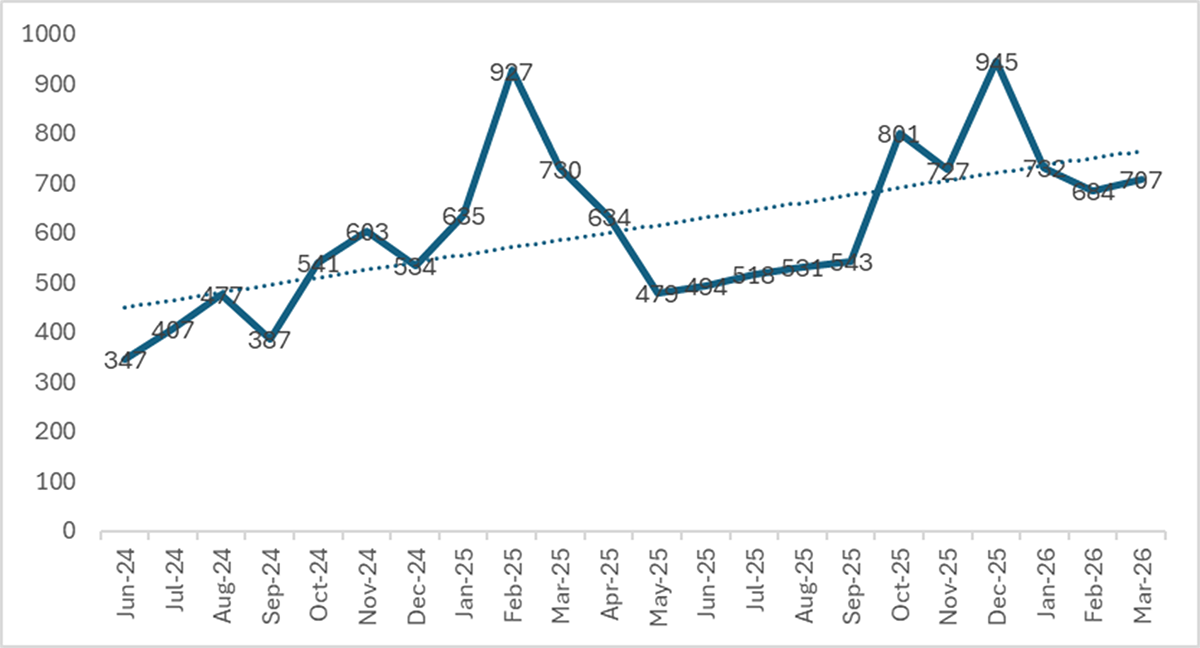
The 2,122 DLS-posted victims in Q1 2026 represent the second-highest Q1 on record, trailing only the all-time high of 2,416 in Q4 2025. But monthly figures show a remarkable consistency: 732 in January, 684 in February, and 706 in March—an average of 707 victims per month. This plateau reflects a stable operating tempo, far removed from the explosive growth seen in prior quarters.
Year-over-year comparisons require careful interpretation. At first glance, Q1 2026’s count is 7.1% lower than Q1 2025’s 2,285 victims. However, the 2025 figure was inflated by Cl0p’s massive Cleo exploitation campaign, which contributed roughly 390 victims in a single month. When Cl0p is removed from both periods, the underlying trend shows a 5.3% year-over-year increase: 1,994 victims in Q1 2026 versus 1,894 in Q1 2025. This subtle but persistent growth signals that ransomware remains a severe and enduring threat.
Dominant Groups: Who Leads the Pack?
Qilin’s Sustained Dominance
For the third consecutive quarter, Qilin sits atop the ransomware leaderboard, posting 338 victims. This consistency is unprecedented in the current era, where group leadership often changes rapidly. Qilin’s operational longevity suggests a mature infrastructure and a steady stream of affiliates.
The Gentlemen: Breakout Story of Q1 2026
The most dramatic rise came from The Gentlemen, which vaulted from 40 victims in Q4 2025 to 166 in Q1 2026, securing third place globally. This more than fourfold increase makes them the fastest-growing major operation. Their rapid expansion raises questions about their recruitment tactics and targeting strategy.
LockBit 5.0: A Confirmed Comeback
LockBit, once the most notorious ransomware group, is showing renewed strength. Its 5.0 variant posted 163 victims in Q1 2026, climbing to fourth place. After a period of diminished activity following law enforcement takedowns, LockBit’s resurgence signals that resilient operators can rebuild quickly.
Implications for Cybersecurity Teams
The consolidation trend has practical consequences. With fewer groups controlling a larger share of attacks, threat intelligence becomes more focused. Defenders can prioritize defenses against the top 10 groups, but these groups are likely to deploy more advanced techniques and larger affiliate networks. The stabilization of attack volumes at a high baseline means organizations cannot afford to relax—ransomware remains a persistent, high-probability risk.
Moreover, the disappearance of 14 smaller groups should not be mistaken for a reduction in overall risk. New groups continue to emerge, and the ecosystem’s churn means that even as some vanish, others take their place. The key takeaway from Q1 2026 is that ransomware is maturing into a more structured, oligopolistic market—and that brings both challenges and opportunities for defenders.
Conclusion: A New Normal?
Q1 2026 may mark the beginning of a new phase in the ransomware threat landscape. Consolidation, stable volumes, and the rise of a few dominant groups suggest an ecosystem that is becoming more predictable in its structure but no less dangerous in its impact. Organizations should use this period of relative organizational stability to strengthen their defenses, particularly against the top operations that now drive most attacks.